
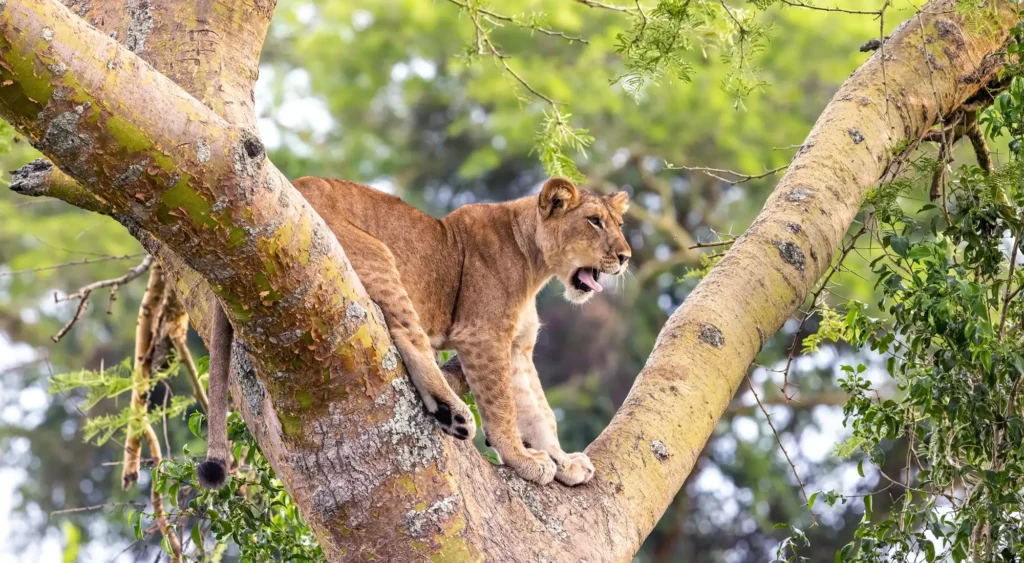
Most lions spend their days in one of three places: in the shade of a bush, draped across a termite mound, or stretched out on a kopje. The lions of Ishasha have other ideas.
The Ishasha sector of Queen Elizabeth National Park, tucked into the southernmost corner of the park near the Uganda-DR Congo border, is home to one of the only populations of tree-climbing lions in the world, the other being in Tanzania’s Lake Manyara National Park. Nobody is entirely sure why the Ishasha lions developed this behaviour: theories range from escaping biting insects on the ground, to gaining better vantage points to spot prey, to simply the fact that it’s rather comfortable up there. The lions don’t seem particularly interested in explaining themselves.
The morning we found them, they were arranged in a magnificent, ridiculous sculpture across three adjacent fig trees: one large female spread-eagled on the thickest branch with the total relaxation of a cat that owns the world; two sub-adults draped less gracefully on lower limbs; and one adolescent male who looked faintly uncertain about the whole enterprise and was clearly questioning whether descending might involve more dignity than the position he’d gotten himself into.
We sat beneath them for forty minutes. Our guide Oliver spoke softly, explaining the pride dynamics: which female was dominant, where the big male had last been seen, how this pride’s territory overlapped with elephant corridors. The lions looked down at us occasionally with supreme, yawning indifference.
Below the trees, the Ishasha floodplain stretched away in every direction: an extraordinary landscape of river, papyrus swamp, and open savannah dotted with African wild sage and gardenia trees. A herd of Uganda kob cantered across the middle distance. A martial eagle circled silently above. The morning light was extraordinary.
The best game drives don’t deliver predictable wildlife — they deliver moments. And a morning beneath the tree-climbing lions of Ishasha is a moment that visits you for years afterwards, arriving unexpectedly when you’re somewhere utterly ordinary and briefly transporting you back to that absurdly improbable scene under the fig trees.